
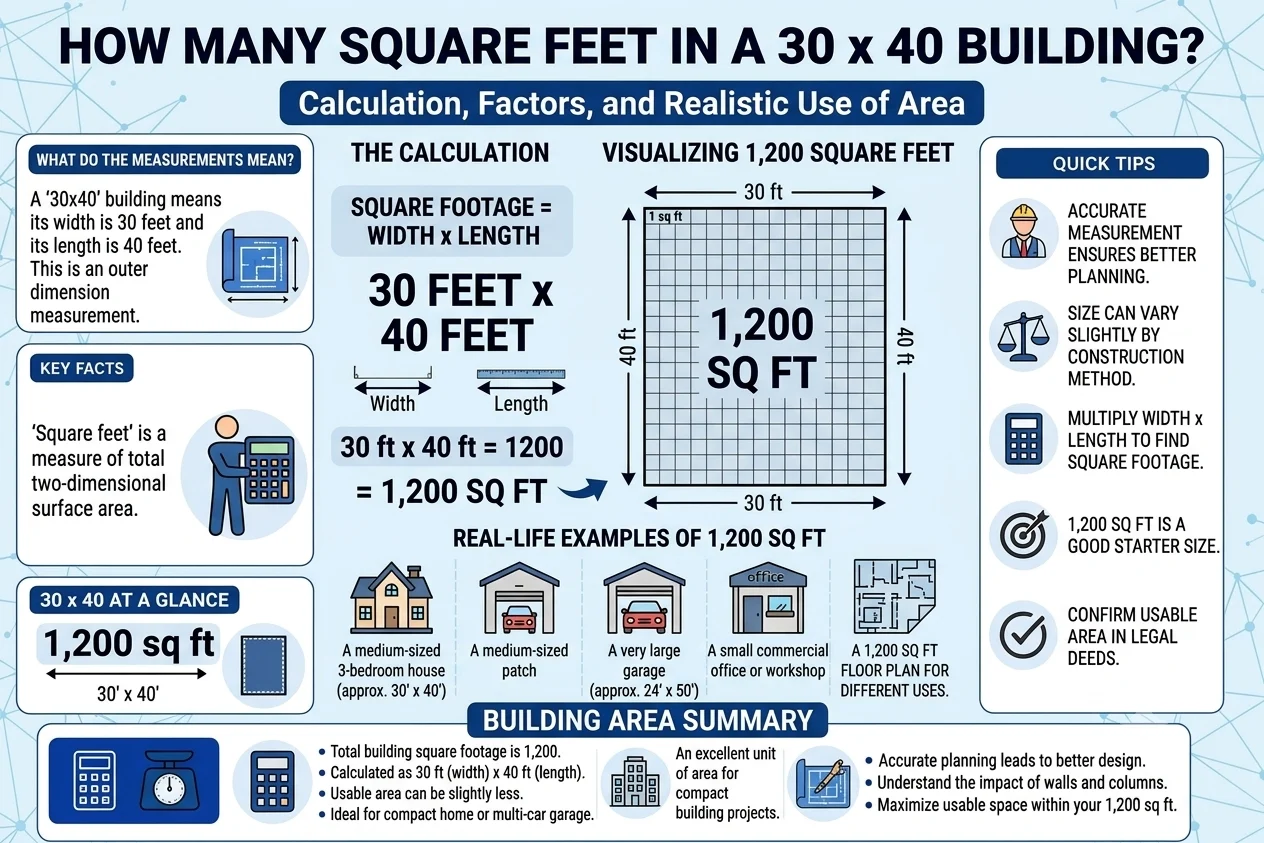
If you’re wondering how many square feet in a 30 x 40 building, the answer is simple: a building that measures 30 feet wide by 40 feet long contains 1,200 square feet of floor space. This size is one of the most popular building dimensions because it offers plenty of room for storage, workshops, garages, small businesses, and even residential layouts.
Understanding square footage helps you estimate construction costs, determine how much equipment or furniture will fit inside, and decide whether a building meets your needs. A 30 x 40 building strikes a balance between affordability and functionality, making it a favorite choice among homeowners and business owners alike.
In this guide, you’ll learn how the calculation works, what 1,200 square feet actually looks like, common uses for a 30 x 40 structure, cost considerations, layout ideas, and practical planning tips.
Quick Answer
A 30 x 40 building contains:
30 × 40 = 1,200 square feet
So the total floor area is:
1,200 square feet
This measurement represents the usable ground-level space within the building footprint.
Understanding Square Footage
Square footage measures the total floor area within a building.
To calculate square footage, use the formula:
Length × Width = Square Feet
For a rectangular building, the process is straightforward.
Example:
- Length = 40 feet
- Width = 30 feet
Multiply them together:
- 40 × 30 = 1,200
Therefore, the building contains 1,200 square feet.
Square footage is important because it affects:
- Construction budgets
- Flooring costs
- Property valuation
- Storage capacity
- Utility requirements
- Interior design planning
How Many Square Feet in a 30 x 40 Building?
The exact answer is:
1,200 square feet
This remains true regardless of whether the building is used as:
- A garage
- A workshop
- A storage facility
- A commercial workspace
- A residential structure
As long as the building measures 30 feet by 40 feet, the footprint remains 1,200 square feet.
What Does 1,200 Square Feet Look Like?
Many people understand numbers but struggle to visualize space.
A 1,200-square-foot building can comfortably fit:
- Three to four vehicles
- A large workshop
- A small office
- Storage shelving
- Farm equipment
- A compact residential layout
For comparison:
| Building Size | Square Feet |
|---|---|
| 20 x 20 | 400 |
| 20 x 30 | 600 |
| 24 x 30 | 720 |
| 30 x 40 | 1,200 |
| 40 x 50 | 2,000 |
A 30 x 40 building offers significantly more usable space than standard residential garages.
Common Uses for a 30 x 40 Building
One reason this size is popular is its flexibility.
Garage
A 30 x 40 garage can typically accommodate:
- Three to four cars
- Trucks
- Motorcycles
- Recreational vehicles
- Tool storage
Many homeowners choose this size because it leaves room for both vehicles and workspace.
Workshop
Whether you’re a woodworker, mechanic, or hobbyist, 1,200 square feet provides enough room for:
- Workbenches
- Equipment
- Tool cabinets
- Storage areas
The open floor plan makes workflow easier.
Small Business Space
Many entrepreneurs use 30 x 40 buildings for:
- Retail operations
- Warehousing
- Fabrication shops
- Repair businesses
The size is often large enough to support daily operations without excessive construction costs.
Storage Building
A 30 x 40 building provides substantial storage capacity for:
- Farm equipment
- Seasonal items
- Inventory
- Household belongings
Sample 30 x 40 Floor Plans
A 30 x 40 building can be configured in many ways.
Open Workshop Layout
- Large central workspace
- Tool storage along walls
- Vehicle access area
Garage and Storage Combination
- Parking area
- Storage section
- Workbench corner
Office and Warehouse Layout
- Front office
- Storage room
- Open workspace
Residential Barndominium Concept
- Living room
- Kitchen
- Bathroom
- Bedroom
- Storage area
Benefits of a 30 x 40 Building
There are several reasons why this size remains popular.
Affordable Construction
Compared to larger structures, a 30 x 40 building generally costs less to build and maintain.
Flexible Design
The layout can be customized for many purposes.
Efficient Use of Land
It provides substantial interior space without requiring a massive lot.
Strong Resale Appeal
Properties with versatile buildings often attract future buyers.
Potential Limitations
Although a 30 x 40 building works for many applications, it may not fit every need.
Potential limitations include:
- Limited room for very large commercial operations
- Insufficient space for multiple RVs
- Expansion may be needed as businesses grow
Planning ahead helps avoid future space constraints.
Construction Costs and Budget Considerations
Construction costs vary based on:
- Location
- Materials
- Foundation type
- Labor rates
- Interior finishes
Factors affecting cost include:
- Metal versus wood construction
- Insulation requirements
- Electrical installation
- Plumbing additions
- HVAC systems
The more customized the building, the higher the overall cost.
Comparing a 30 x 40 Building to Other Sizes
| Size | Square Feet |
|---|---|
| 24 x 24 | 576 |
| 24 x 30 | 720 |
| 30 x 30 | 900 |
| 30 x 40 | 1,200 |
| 40 x 40 | 1,600 |
| 40 x 50 | 2,000 |
The 30 x 40 size sits comfortably in the middle range, offering excellent value for most buyers.
Tips for Maximizing Space
To get the most from a 30 x 40 building:
- Use vertical storage
- Install shelving systems
- Create designated work zones
- Utilize overhead storage
- Choose multifunctional furniture
- Keep pathways clear
Smart organization can make the building feel much larger than its actual dimensions.
Common Mistakes to Avoid
When planning a 30 x 40 building, avoid these common errors:
Underestimating Storage Needs
Many owners eventually need more storage than expected.
Ignoring Future Expansion
Think about how your needs may change over time.
Poor Layout Planning
An inefficient floor plan can waste valuable square footage.
Forgetting Utility Requirements
Electrical, plumbing, and HVAC systems should be planned early.
Conclusion
If you’re asking how many square feet in a 30 x 40 building, the answer is straightforward:
A 30 x 40 building contains 1,200 square feet.
This size offers an excellent balance of affordability, flexibility, and functionality. Whether you’re building a garage, workshop, storage facility, small business space, or residential structure, 1,200 square feet provides enough room for a wide variety of uses.
By understanding the square footage, planning your layout carefully, and considering future needs, you can make the most of every square foot in your 30 x 40 building.
FAQs
How many square feet is a 30 x 40 building?
A 30 x 40 building contains 1,200 square feet.
How do you calculate square footage for a 30 x 40 building?
Multiply the length by the width:
30 × 40 = 1,200 square feet.
Is a 30 x 40 building large enough for a workshop?
Yes. A 30 x 40 workshop provides ample room for equipment, storage, and work areas.
How many cars fit in a 30 x 40 garage?
Most 30 x 40 garages can comfortably accommodate three to four vehicles, depending on the layout.
Is a 30 x 40 building a good investment?
For many homeowners and small businesses, a 30 x 40 building offers excellent value because of its versatility and practical size.
Discover More
163 Centimeters Is How Many Feet?
How Many Feet Is 0.6 Miles?
How Many Feet Does a Rooster Have?