
If you’ve ever wondered how many feet is 3500 meters, you’re not alone. This is a common conversion question for travelers, hikers, engineers, students, and construction professionals.
The quick answer is:
3500×3.28084≈11482.94
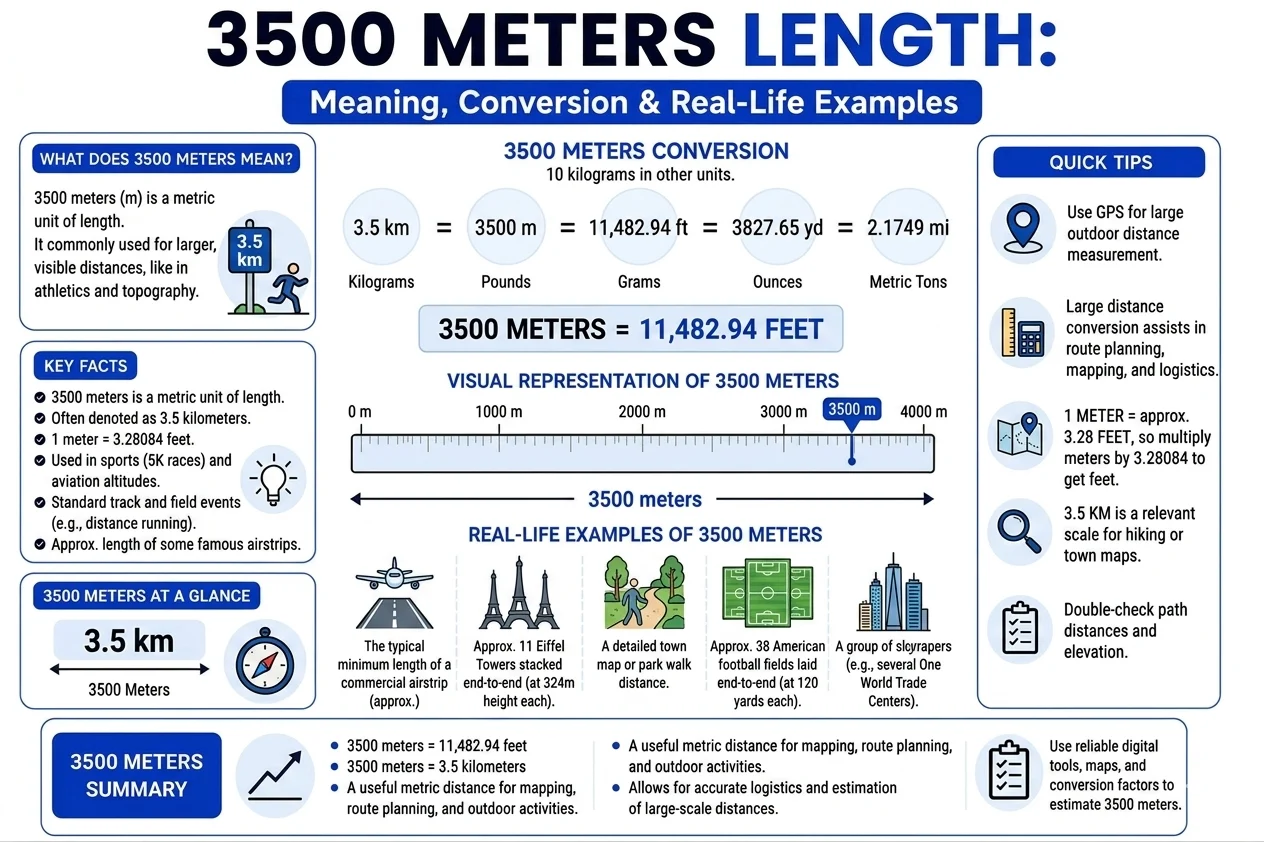
So, 3500 meters equals approximately 11,482.94 feet.
Understanding this conversion can help when reading maps, comparing elevations, planning construction projects, or interpreting international measurements. In this guide, you’ll learn the exact formula, practical examples, conversion charts, and useful tips for converting meters into feet accurately.
Quick Answer to How Many Feet Is 3500 Meters
To convert meters into feet, multiply the number of meters by 3.28084.
The calculation looks like this:
3500×3.28084≈11482.94
Final Answer
3500 meters = 11,482.94 feet
Rounded to the nearest foot:
3500 meters ≈ 11,483 feet
Understanding Meters and Feet
Before converting measurements, it helps to understand the units involved.
What Is a Meter?
A meter is the standard unit of length in the metric system.
It is commonly used in:
- Science
- Engineering
- Construction
- Athletics
- International measurements
One meter equals:
- 100 centimeters
- 1,000 millimeters
What Is a Foot?
A foot is a unit of length in the imperial and U.S. customary systems.
It is commonly used in:
- Construction
- Real estate
- Aviation
- Everyday measurements in the United States
One foot contains:
12 inches
Why Convert Between Them?
Many countries use the metric system, while others rely on feet and inches.
Converting between these units helps with:
- Reading international specifications
- Understanding elevation data
- Comparing measurements
- Working with global teams
How Many Feet Is 3500 Meters? Step-by-Step Calculation
Let’s break the conversion into simple steps.
The Conversion Formula
The standard formula is:
Feet=Meters×3.28084
Multiply by 3.28084
Insert 3500 meters into the formula:
3500×3.28084
The result is:
11482.94
Final Result
Therefore:
3500 meters = 11,482.94 feet
Or approximately:
11,483 feet
3500 Meters to Feet Conversion Chart
The table below shows nearby meter values and their equivalent lengths in feet.
| Meters | Feet |
|---|---|
| 1000 | 3,280.84 |
| 1500 | 4,921.26 |
| 2000 | 6,561.68 |
| 2500 | 8,202.10 |
| 3000 | 9,842.52 |
| 3500 | 11,482.94 |
| 4000 | 13,123.36 |
| 4500 | 14,763.78 |
| 5000 | 16,404.20 |
This chart provides a quick reference for common conversions.
Real-World Examples of 3500 Meters
Understanding the size of 3500 meters becomes easier when compared to real-life situations.
Mountain Elevation
Many mountain peaks around the world exceed 3500 meters.
An elevation of 3500 meters means:
- Approximately 11,483 feet above sea level
At this altitude, the air becomes noticeably thinner, and some people may experience mild altitude effects.
Running and Sports
A distance of 3500 meters is equal to:
- 3.5 kilometers
This distance is commonly used in training sessions and endurance workouts.
When converted to feet, athletes gain a better understanding of the total distance covered.
Construction and Engineering
Large-scale projects often involve measurements in both metric and imperial units.
Engineers may need to convert 3500 meters into feet when:
- Reviewing international blueprints
- Coordinating with global contractors
- Calculating elevations
Why Understanding Meter-to-Feet Conversion Matters
Knowing how many feet is 3500 meters is useful in many situations.
International Communication
Different countries use different measurement systems.
Understanding both helps avoid confusion when:
- Reading technical documents
- Working on international projects
- Traveling abroad
Travel and Navigation
Maps, GPS systems, and hiking guides often display distances and elevations using different units.
Converting meters into feet makes these measurements easier to understand.
Professional Applications
Accurate conversions are important in:
- Engineering
- Architecture
- Aviation
- Surveying
- Construction
Even small errors can create costly mistakes.
Comparing Meters and Feet
Here’s a simple comparison between the two units.
| Measurement | Equivalent |
|---|---|
| 1 meter | 3.28084 feet |
| 10 meters | 32.81 feet |
| 100 meters | 328.08 feet |
| 1000 meters | 3,280.84 feet |
| 3500 meters | 11,482.94 feet |
This comparison highlights how quickly measurements grow when converted into feet.
Common Mistakes When Converting Meters to Feet
Even simple conversions can lead to errors.
Using the Wrong Conversion Factor
Some people round too aggressively.
The correct conversion factor is:
1 meter=3.28084 feet
Using inaccurate values can affect results.
Forgetting to Multiply
To convert meters to feet, always multiply.
Do not divide.
The correct formula is:
Feet=Meters×3.28084
Rounding Too Early
Rounding during calculations can create inaccuracies.
For best results:
- Complete the calculation first
- Round only the final answer
Expert Tips for Accurate Measurement Conversions
Professionals use several methods to ensure accuracy.
Memorize the Conversion Factor
Remember:
1 meter=3.28084 feet
This makes future conversions much faster.
Use Digital Calculators
For engineering and construction projects, use calculators to maintain precision.
Double-Check Important Measurements
Before making decisions based on converted values:
- Verify calculations
- Confirm units
- Check rounding
These habits reduce mistakes.
Learn Approximation Techniques
For quick estimates:
- Multiply meters by 3.3
Example:
3500×3.3≈11550
This estimate is close to the actual answer of 11,482.94 feet.
Practical Uses of the Conversion
Knowing how many feet is 3500 meters can be useful in many situations:
- Reading mountain elevation signs
- Understanding aviation altitude data
- Comparing international building heights
- Interpreting engineering drawings
- Planning outdoor adventures
The ability to switch between measurement systems improves understanding and communication.
Quick Reference Formula
Whenever you need to convert meters into feet, use:
Feet=Meters×3.28084
For 3500 meters:
3500×3.28084≈11482.94
Conclusion
If you were asking how many feet is 3500 meters, the answer is:
3500 meters=11482.94 feet
Or rounded:
3500 meters ≈ 11,483 feet
This conversion is useful in travel, engineering, construction, aviation, and outdoor activities. By understanding the conversion formula and practicing a few examples, you can confidently convert meters into feet whenever needed.
Frequently Asked Questions
How many feet is 3500 meters exactly?
3500 meters equals approximately 11,482.94 feet.
What formula converts meters to feet?
Use:
Feet=Meters×3.28084
Is 3500 meters higher than 10,000 feet?
Yes. 3500 meters equals approximately 11,483 feet.
Why do some countries use meters instead of feet?
Most countries use the metric system because it is standardized and easier for scientific calculations.
Can I estimate meters to feet without a calculator?
Yes. Multiply the number of meters by approximately 3.3 for a quick estimate. For 3500 meters, that gives about 11,550 feet, which is close to the exact value.
Find out More
How Many Miles Is 60,000 Feet?
How Many 16 Inches in 24 Feet?