

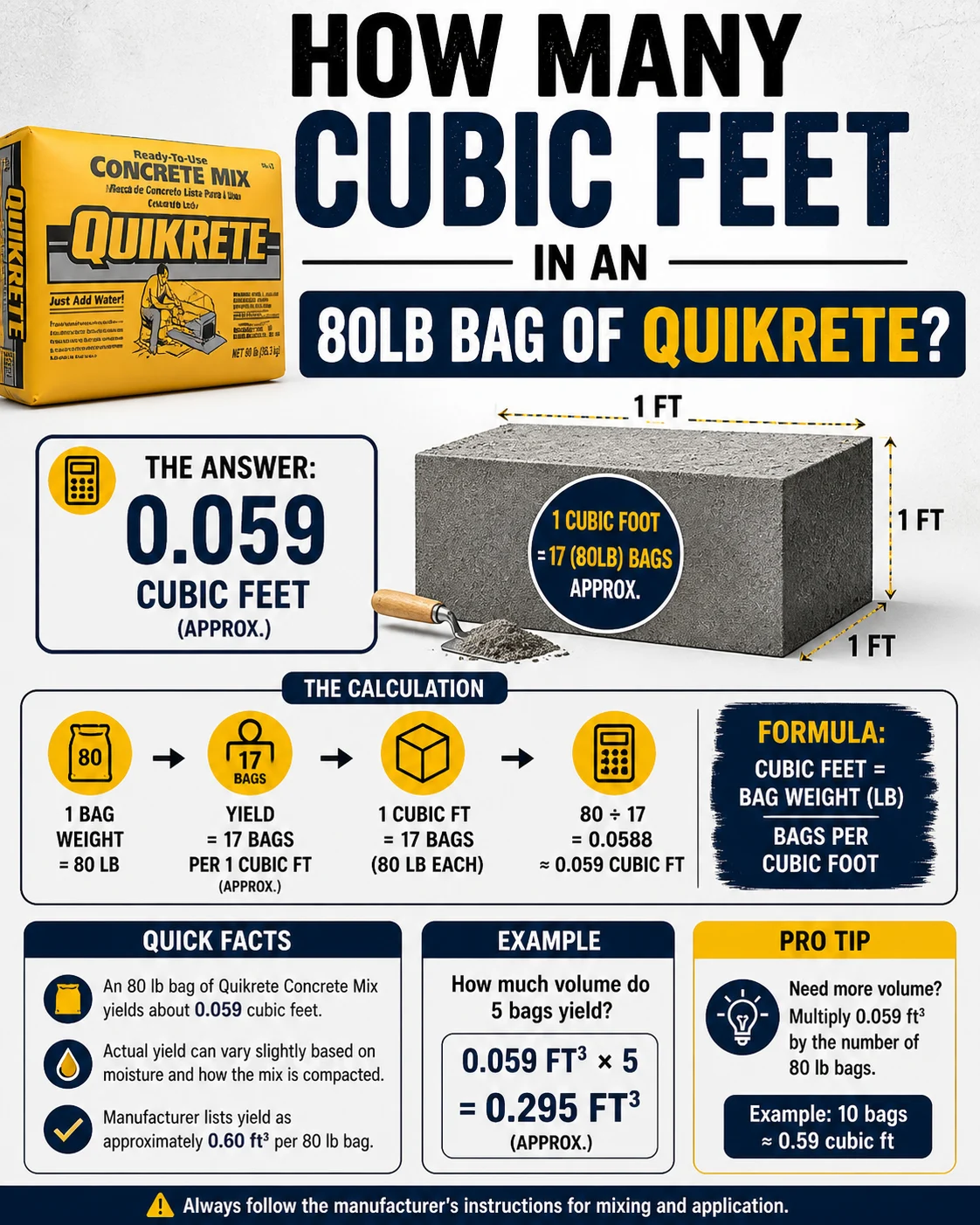
If you’re planning a concrete project, one of the first questions you’ll ask is: how many cubic feet in an 80lb bag of Quikrete?
Here’s the quick answer:
👉 An 80lb bag of Quikrete yields approximately 0.60 cubic feet of concrete.
That means each bag fills just over half a cubic foot when mixed properly.
But to avoid running out of concrete—or wasting money—you need to understand how this number works in real projects. This guide will walk you through calculations, coverage charts, and expert tips to get it right the first time.
Quick Answer: How Many Cubic Feet in an 80lb Bag of Quikrete?
Let’s break it down clearly:
- 1 bag (80 lb) = 0.60 cubic feet
- 2 bags = 1.2 cubic feet
- 10 bags = 6 cubic feet
👉 So, if your project requires 6 cubic feet of concrete, you’ll need about 10 bags.
Understanding Concrete Volume and Yield
Before calculating anything, you need to understand what “cubic feet” means.
What Is a Cubic Foot?
A cubic foot is a volume measurement:
- 1 ft × 1 ft × 1 ft = 1 cubic foot
It tells you how much space something fills.
Why Yield Matters
Concrete bags don’t just represent weight—they represent volume after mixing.
Yield helps you:
- Estimate how many bags to buy
- Avoid shortages
- Control costs
Quikrete 80lb Bag Yield Explained
An 80lb bag of Quikrete typically produces:
👉 0.60 cubic feet of finished concrete
Why Not 1 Cubic Foot?
Because:
- The dry mix contains air gaps
- Water activates and compacts the mix
- The final volume is smaller than the dry ingredients
Key Fact:
👉 1 cubic yard = 27 cubic feet
This becomes important for larger projects.
Coverage Chart for 80lb Bag of Quikrete
Here’s how much area one bag can cover depending on thickness:
| Thickness | Coverage per 80lb Bag |
|---|---|
| 2 inches | 3.6 sq ft |
| 3 inches | 2.4 sq ft |
| 4 inches | 1.8 sq ft |
| 6 inches | 1.2 sq ft |
👉 Thicker slabs require more concrete.
How to Calculate Concrete Needed (Step-by-Step)
Follow this simple method:
Step 1: Measure Area
Length × Width
Example:
- 10 ft × 10 ft = 100 sq ft
Step 2: Convert Thickness to Feet
4 inches ÷ 12 = 0.33 ft
Step 3: Calculate Volume
Volume = Area × Thickness
100 × 0.33 = 33 cubic feet
Step 4: Divide by Bag Yield
33 ÷ 0.60 = 55 bags
👉 You’ll need about 55 bags of 80lb Quikrete
How Many 80lb Bags Make a Cubic Yard?
Let’s convert cubic feet to cubic yards.
Formula:
1 cubic yard = 27 cubic feet
Now divide:
👉 27 ÷ 0.60 = 45 bags
Final Answer:
👉 45 bags of 80lb Quikrete = 1 cubic yard
Quick Reference:
| Cubic Yards | Bags Needed |
|---|---|
| 1 yard | 45 bags |
| 2 yards | 90 bags |
| 3 yards | 135 bags |
Real-Life Project Examples
1. Fence Post Installation
Hole size:
- 1 ft diameter
- 2 ft deep
Volume:
👉 ~1.57 cubic feet
Bags needed:
👉 1.57 ÷ 0.60 ≈ 3 bags per post
2. Small Patio Slab
Size:
- 8 ft × 10 ft
- 4 inches thick
Volume:
👉 26.4 cubic feet
Bags:
👉 44 bags
3. Deck Footings
Each footing:
- 1 cubic foot
👉 Requires about 2 bags per footing
Factors That Affect Concrete Yield
The 0.60 cubic feet is an estimate. Actual yield can vary.
1. Water Ratio
Too much water:
- Weakens concrete
- Slightly increases volume
Too little:
- Hard to mix
- Reduces workability
2. Mixing Method
- Hand mixing may be uneven
- Machine mixing is more consistent
3. Compaction
Air pockets reduce strength and volume accuracy.
4. Waste and Spillage
Always add 5–10% extra for safety.
Common Mistakes to Avoid
1. Not Calculating Volume Properly
Skipping thickness conversion leads to wrong estimates.
2. Buying Exact Amount Only
Always buy extra bags.
3. Ignoring Depth Variations
Uneven ground changes required volume.
4. Using Wrong Bag Size
Not all bags yield the same volume.
Expert Tips for Using Quikrete
Want professional-level results? Follow these tips:
- Always measure twice before buying
- Add water gradually while mixing
- Use a wheelbarrow or mixer for consistency
- Compact concrete to remove air bubbles
- Finish surface quickly before it sets
Comparison: 60lb vs 80lb vs 90lb Bags
| Bag Size | Yield (Cubic Feet) |
|---|---|
| 60 lb | 0.45 |
| 80 lb | 0.60 |
| 90 lb | 0.67 |
👉 Larger bags reduce the number of bags needed.
Practical Use Cases
When to Use 80lb Bags:
- Medium projects
- Fence posts
- Small slabs
When to Avoid:
- Large driveways
- Big foundations (use ready-mix instead)
FAQs
1. How many cubic feet in an 80lb bag of Quikrete exactly?
An 80lb bag yields approximately 0.60 cubic feet of concrete.
2. How many bags do I need for 1 cubic yard?
You need about 45 bags of 80lb Quikrete.
3. How much area does one bag cover?
It covers about 1.8 sq ft at 4 inches thick.
4. Should I buy extra concrete bags?
Yes, always add 5–10% extra to avoid shortages.
5. Can yield vary from 0.60 cubic feet?
Yes, depending on water, mixing, and compaction.
Conclusion
So, let’s answer it clearly:
👉 How many cubic feet in an 80lb bag of Quikrete?
It yields approximately 0.60 cubic feet.
This simple number is essential for planning any concrete project. Whether you’re setting fence posts, pouring a slab, or building a patio, knowing the yield helps you estimate accurately and avoid costly mistakes.
Remember:
- 1 bag = 0.60 cubic feet
- 45 bags = 1 cubic yard
- Always calculate volume before buying
With this knowledge, you can confidently plan your next project and get professional-quality results.

Pingback: How Many Square Feet Is Graceland House? Complete Guide
Pingback: How Many Square Feet Is 30" x 35'? Complete Guide